Photos Are Part of the Description
Please review all photos carefully. For used, vintage, collectible, and one-of-a-kind items, the images help show condition, wear, markings, and included details.
Buyer Confidence
Buy With Confidence from SalarsNet
- •Actual item photos are included so you can inspect details before buying.
- •Condition notes are written carefully based on visible wear and available information.
- •Used, vintage, and collectible items may show normal age-related wear.
- •Questions are welcome before purchase.
Human Help
Want Me to Check Something First?
Need another photo, measurement, closeup, copyright page check, or other detail confirmed before you order? Contact me before purchase and I will do my best to help.
Condition Guide
How I Describe Condition
Used and vintage items are described based on visible wear, photos, age, markings, and available details. See the Condition Guide for the terms I use.
Authenticity Policy
What I Do and Don’t Claim
I avoid unsupported claims about authenticity, grading, rarity, provenance, or investment value. If a detail is uncertain, I say so plainly.
Questions before purchase are welcome. Seller contact, shipping details, and return terms are published before checkout.
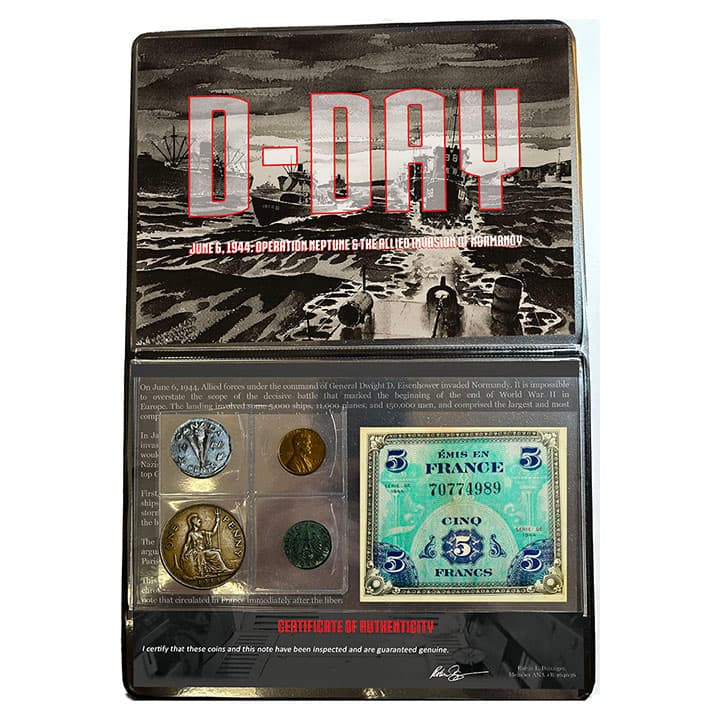
D-Day: June 6, 1944, Operation Neptune & The Allied Invasion of Normandy (five piece album)
Description
On June 6, 1944, Allied forces under the command of General Dwight D. Eisenhower invaded Normandy. It is impossible to overstate the scope of the decisive battle that marked the beginning of the end of World War II in Europe. The landing involved some 5,000 ships, 11,000 planes, and 150,000 men, and comprised the largest and most complex air-, sea-, and land operation ever attempted, before or since. In January of 1944, Eisenhower assumed command of the operation, codenamed Neptune. Ike picked the date of the invasion—June 5—and oversaw the massive disinformation campaign designed to trick Hitler into thinking the landing would be at Calais, 400 kilometers to the north. Inclement weather delayed the invasion by 24 hours, and helped lull the Nazis into a false sense of security, as the skies were cloudier at Calais than at Normandy. Not only that, but many of the top German brass were on leave the day of the invasion, including famed general Erwin Rommel. First, three divisions of paratroopers were dropped inland, to protect the flanks. Before dawn, hundreds of amphibious ships crossed the English Channel. Then, at sunrise, six full divisions—three American, two British, and one Canadian— stormed the shore at five points along the shore, code-named Utah, Omaha, Gold, Juno, and Sword. By the end of the day, the beachhead was secure. The Nazis were completely surprised by the attack. By the time Rommel arrived at the battlefield, the battle—and, arguably, the war—was lost. With a toehold at Normandy, the Allies poured men and matériel into France. By August, Paris was liberated from Nazi clutches. Within a year, Hitler was dead, and the war in Europe would be over. This remarkable collection features four coins circulating in 1944—a U.S. penny; a Canadian “V” nickel made of chrome-plated steel; a British penny; and a zinc 5 pfennig of Nazi Germany—as well as a 5 franc Allied Military Currency note that circulated in France immediately after the liberation.
Packaging: deluxe album.
Images are representative of the type and general grade. The date, mint, color, toning, and exact coins received may vary unless the listing explicitly says the actual lot is shown.