Photos Are Part of the Description
Please review all photos carefully. For used, vintage, collectible, and one-of-a-kind items, the images help show condition, wear, markings, and included details.
Buyer Confidence
Buy With Confidence from SalarsNet
- •Actual item photos are included so you can inspect details before buying.
- •Condition notes are written carefully based on visible wear and available information.
- •Used, vintage, and collectible items may show normal age-related wear.
- •Questions are welcome before purchase.
Human Help
Want Me to Check Something First?
Need another photo, measurement, closeup, copyright page check, or other detail confirmed before you order? Contact me before purchase and I will do my best to help.
Condition Guide
How I Describe Condition
Used and vintage items are described based on visible wear, photos, age, markings, and available details. See the Condition Guide for the terms I use.
Authenticity Policy
What I Do and Don’t Claim
I avoid unsupported claims about authenticity, grading, rarity, provenance, or investment value. If a detail is uncertain, I say so plainly.
Questions before purchase are welcome. Seller contact, shipping details, and return terms are published before checkout.
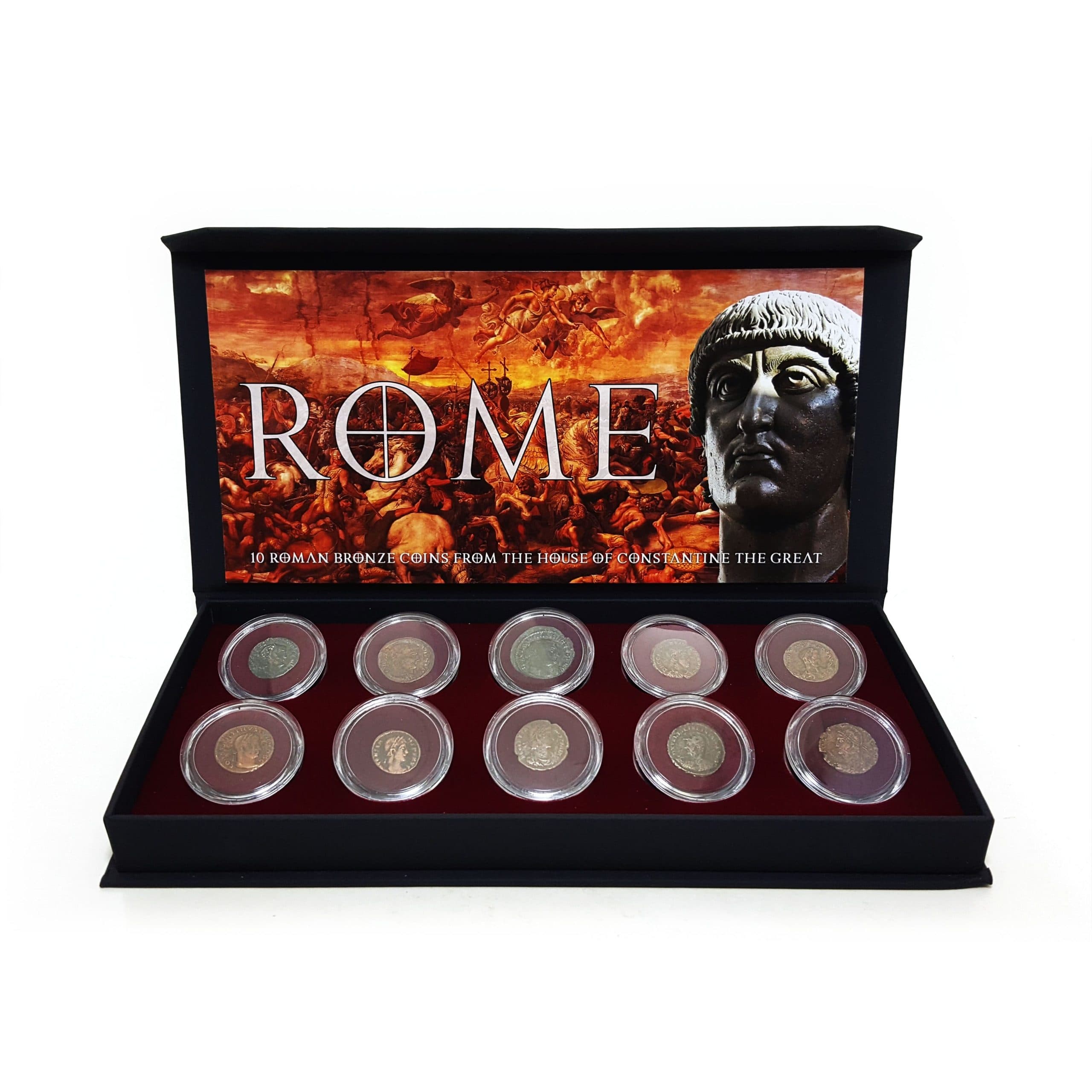
House of Constantine: A Collection of 10 Roman Bronze Coins
Description
Constantine the Great was the first Christian Emperor of Rome, the founder of the Byzantine Empire and its capital city of Constantinople, and arguably the most historically significant Roman ruler of the Common Era. In 312, while at battle, Constantine had a vision of a flaming cross in the sky at noon. He interpreted this as a sign that he should engage his legions in a holy war to wrest control of the entire Roman Empire, and to proclaim Christianity as the state religion. Guided by divine inspiration, he succeeded, winning territory from the Franks, the Visigoths, and the Sarmatians, and expanding imperial territory. His other accomplishments include issuing the Edict of Milan, which made Christianity legal; working with Pope Sylvester I to establish the Papacy in Rome; and building the Old St. Peter’s Basilica, the Church of the Holy Sepulchre, and the Arch of Constantine. When Constantine took the throne upon the death of his father, Constantius I Chlorus, Rome was in the midst of political and economic chaos—a period his reign helped end. He put down his rival Licinius I and his son Licinius II, consolidating his power. His sons—Constantine II, Constans I, and Constantius II—all ascended to the throne, establishing the Constantine Dynasty, the most significant since the days of Caesar Augustus. Another son, Crispus, also had coins minted with his portrait, as did his nephew Constantine Gallus. Julian II, was the last of the House of Constantine. This collection contains ten coins: 1/ Constantius I Chlorus, 305-6 2/ Constantine the Great, 306-337 3/ Licinius I, 308-324; 4/ Licinius II, 317-24 5/ Crispus, 317-326 6/ Constantine II, 337-340 7/ Constans, 337-350 8/ Constantius II, 337-361 9/ Constantius Gallus, 351-54; 10/ Julian II, 360-363
Packaging: wood box.
Images are representative of the type and general grade. The date, mint, color, toning, and exact coins received may vary unless the listing explicitly says the actual lot is shown.