Ready to put this into action?
Get the complete Frontier Wisdom Collection — History, legends, and timeless wisdom from the American frontier — resilience, grit, and self-reliance.
The Santa Fe Trail Began as a Trade Route, Not a Wagon-Train Myth
What changed when merchants connected Missouri with Santa Fe in 1821?
Recommended Resource
Frontier Wisdom Collection
History, legends, and timeless wisdom from the American frontier — resilience, grit, and self-reliance.
The Santa Fe Trail Began as a Trade Route, Not a Wagon-Train Myth
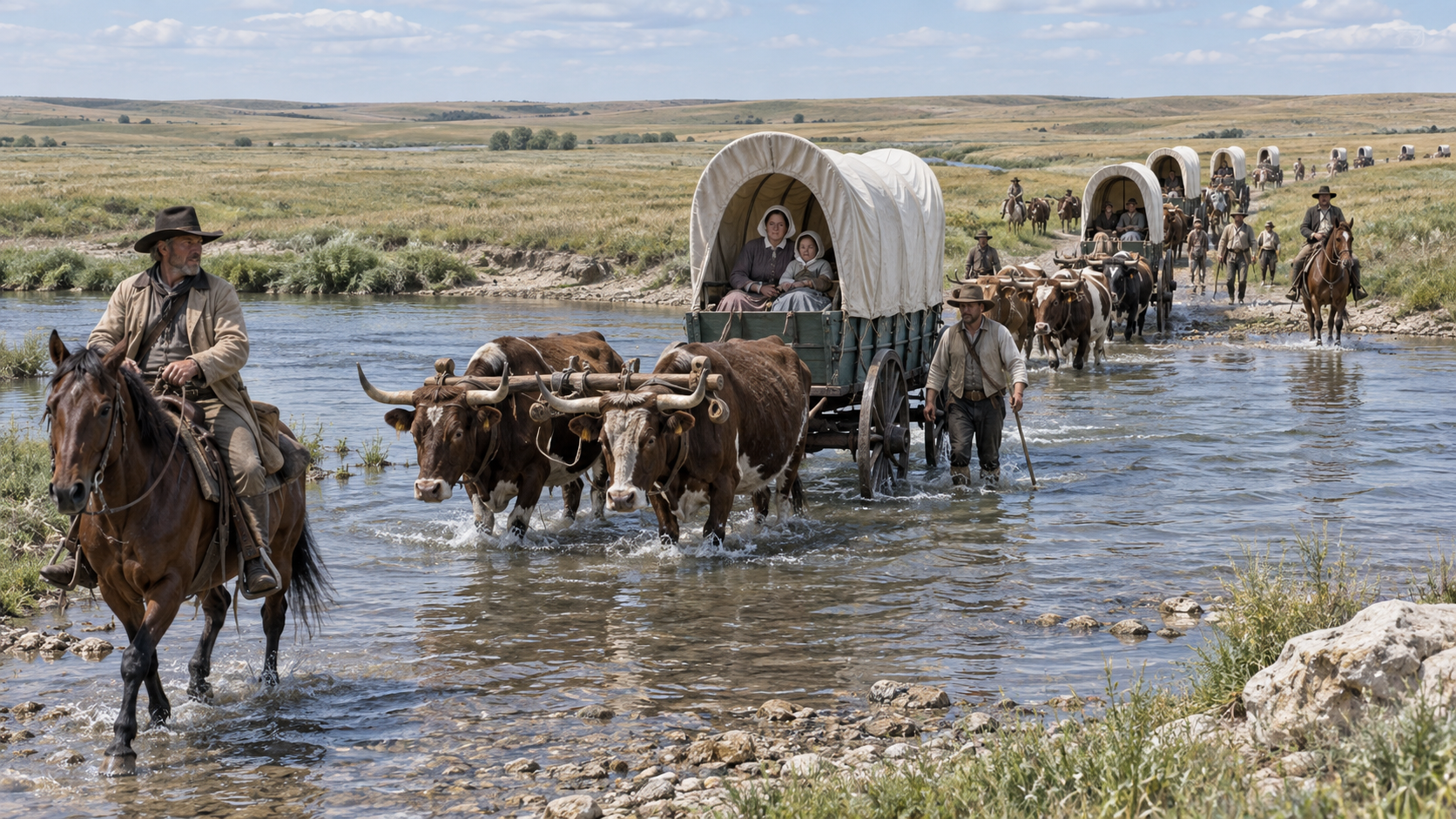
Source-led question: What changed when merchants connected Missouri with Santa Fe in 1821?
The Santa Fe Trail is often pictured as a line of wagons moving through an empty landscape. The record points to a different starting point. The trail was a commercial route linking merchants in Missouri with Santa Fe in New Mexico. Its importance came from exchange: manufactured goods traveled west, and regional products, information, and opportunities traveled east. The wagon train was the visible part of a trade system that already had deep local context. The National Park Service describes a route of roughly eight hundred miles. In eighteen twenty-one, William Becknell and a small party left Missouri and reached Santa Fe with goods to sell. That journey did not create travel across the plains, but it helped establish a route that merchants could use repeatedly. Trade turned a difficult crossing into a pattern of departures, landmarks, and expected destinations. A trail is not aA trail is not a single road but a negotiated pattern of terrain, commerce, and trust.
What the record supports
- Documented: The Santa Fe Trail ran roughly 800 miles between Missouri and Santa Fe.
- Documented: William Becknell's 1821 journey helped open the route to sustained U.S.–New Mexico trade.
- Documented: Merchants used the trail to carry manufactured goods and supplies into New Mexico.
- Documented: The trail developed alternative branches across the plains rather than one unchanging track.
- Documented: Trade and conflict along the trail affected Indigenous nations whose histories predated the route.
The episode uses clearly labeled synthetic reconstruction imagery for explanation. Those images are not archival photographs and do not establish that an uncertain detail was witnessed.
The source trail keeps documented facts separate from inference. The episode follows the strongest available records and leaves unresolved parts visible; a missing record is not evidence for a precise route, invented dialogue, recovered object, or modern valuation.
Continue the series
- Western Stories index
- Old West hub
- Continue with the next source trail
- Subscribe to Old West source trails
Sources
- Trail Beginnings & Geographic Setting — The trail extends about 800 miles from Independence, Missouri, to present-day Santa Fe, New Mexico.
- Trailwide Research: Santa Fe National Historic Trail — NPS research includes the trail's impact on Indigenous nations and the histories of the Pawnee, Comanche, Shawnee, and Delaware.
- The Santa Fe Trail, 1821–2021 — The route begins in Missouri and crosses Kansas before splitting toward Santa Fe.
Media note: This page uses an authorized synthetic reconstruction image. The historical claims remain tied to the source links above.
Get the Old West Dispatch
Weekly insights on old west — delivered to your inbox. No spam, unsubscribe any time.
Want to choose specific topics? Customize your interests
Get the Old West Dispatch
Weekly insights on old west — delivered to your inbox. No spam, unsubscribe any time.
Want to choose specific topics? Customize your interests