Ready to put this into action?
Get the complete Frontier Wisdom Collection — History, legends, and timeless wisdom from the American frontier — resilience, grit, and self-reliance.
Fort Union: The Supply Depot That Kept the Southwest’s Army Moving
The complete narration, historical sources and research notes for this Western Stories episode.
Recommended Resource
Frontier Wisdom Collection
History, legends, and timeless wisdom from the American frontier — resilience, grit, and self-reliance.
Explore the evidence behind this Western Stories episode, then follow the source links to read the records for yourself. This page includes the complete narration and a research guide.
The story
A fort built to keep other forts working
What kept an army moving across the nineteenth-century Southwest? At Fort Union, the answer included warehouses, carpenters, mule teams, and a great deal of paperwork. The ruins in northeastern New Mexico belonged to more than a place where soldiers slept and stood guard. This was a supply center that helped other forts keep working. Its history becomes easier to see when we follow an ordinary object: a wagon wheel, a window frame, or a sack of feed. Each needed materials, labor, transport, and an account of where it went. Fort Union brought those jobs together beside the Santa Fe Trail.
The first fort: a useful location, poor buildings
The first Fort Union was established in eighteen fifty-one under Lieutenant Colonel Edwin Sumner. The site lay near the Mountain and Cimarron branches of the Santa Fe Trail, a useful position for moving supplies through the region. Sumner moved the headquarters and main supply depot away from Santa Fe. But a promising location did not guarantee good housing. The first post's log buildings deteriorated. The National Park Service describes decaying timber, leaking roofs, and insects finding shelter in the unbarked logs. A fort could be important on a military map while remaining a miserable place to live. That first version lasted through the eighteen fifties.
The second fort answered a different threat
The Civil War changed the problem. In eighteen sixty-one, a second fort began taking shape as an earthwork designed for defense. Its star-shaped outline belonged to a period when Union forces faced the danger of a Confederate advance into New Mexico. This was a different answer from the first log post, and it was different again from the large complex that followed. The phrase Fort Union can make the place sound like one building that slowly grew old. In fact, the site held three successive forts. Their different forms help us recognize the different demands the army placed on this patch of ground.
The third fort expanded the supply system
During the eighteen sixties, the third fort developed into a much larger complex. Adobe walls stood on stone foundations and were covered with plaster. Some materials came from the surrounding country. Others, including tools, nails, window glass, and roofing materials, traveled along the Santa Fe Trail. The handsome buildings still needed constant attention. Leaking roofs damaged adobe and brought repair crews back to work. The military post was only part of the establishment. The quartermaster depot supported other New Mexico forts, while the ordnance depot dealt with weapons and ammunition. Supplying a region required more than storing a pile of goods behind a gate.
An inspector walks through the depot
An inspection report brings the busy place into focus. In June eighteen sixty-eight, Major Andrew Evans described the quartermaster depot after examining its buildings, workers, equipment, and accounts. His report moves through offices and warehouses, then into the mechanics' shops and animal corrals. There were clerks responsible for different books and papers, workers caring for tools, and men making repairs. The details become wonderfully specific. A tinner was repairing roofs. Coopers made and repaired containers. Blacksmiths and wheelwrights worked on wagon equipment. These are the activities hidden behind the simple word supply. Before something could be issued, somebody often had to mend it.
A window frame could begin its journey here
In the carpenter shops, Evans found men making doors and window sash for Fort Bascom. That small entry opens up the whole system. Work done at Fort Union could become part of a building at another post. The same report describes harness shops, painting, metalwork, and wagon materials waiting for use. It is a picture of a repair and manufacturing center as well as a storehouse. The National Park Service notes that the depot was larger than the military post and employed more men, mostly civilians. Uniformed soldiers depended on skills that did not stop at the edge of a parade ground.
Mules, water and the cost of movement
Moving supplies created its own demands. Mule teams needed feed, water, sound harness, and care. Evans inspected road teams, water wagons, wood wagons, and animals that were sick or worn down. A repaired wagon was of limited use if the animals pulling it could not work. His inspection also compared stores of forage with the amounts listed in the records. The figures did not always agree, and he acknowledged that his own rough measurements could be wrong. The report is valuable partly because it preserves those difficulties. Even a well-managed depot had to struggle with counting, maintenance, distance, and the condition of living animals.
Supplies also carried military power
This practical work served purposes larger than the depot itself. Fort Union supported travel and commerce, but it also supported an army extending United States control through Native homelands. Supplies helped sustain patrols and military campaigns. The growth of traffic along the Santa Fe Trail disrupted Native communities and the country they depended on. Describing the fort only as protection leaves out that part of the story. The same wagon train could represent security to one community and the reach of an advancing military power to another. Understanding the supply system helps explain how that power could operate far from its original centers.
The railroad changed the fort’s importance
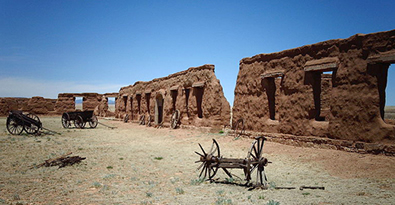
Railroad arrival in eighteen seventy-nine gradually reduced the importance of traffic over the Santa Fe Trail. Fort Union remained in operation for years afterward, but the transport system around it was changing. The army abandoned the post in eighteen ninety-one. The photograph shows surviving ruins long after that closure, with an outdoor interpretive display, not a wagon yard still at work. Behind those walls once stood a network of storage, skilled labor, accounts, and animal transport. The companion source trail includes Evans's inspection report. Read its workshop entries, and these ruins become easier to imagine accurately: a place where keeping other places supplied was a daily occupation.
Explore the source trail
These sources are free to read. No purchase or newsletter signup is required.
-
New Mexico: Fort Union National Monument: Fort Union: An Evolution of Protection; image caption explicitly Public Domain Image
-
The First Fort Union: Opening account of Sumner and 1851 establishment; description of log buildings
-
The Third Fort Union: Territorial construction; Cistern and Supply Depot; railroad arrival and 1891 closure
-
Major Andrew E. Evans: Fort Union Quartermaster Depot inspection, June 16, 1868: Appendix L, full report excerpt; opening inventory, mechanics corral, carpenter shops, forage comparisons, conclusion. Citation: Evans to AAAG DNM, June 16, 1868, LR, OIG, RG 159, National Archives.
Read the inspection as a dated snapshot
Major Andrew E. Evans’s June 16, 1868 inspection is a contemporary account preserved here in a published transcription. The citation points to National Archives Record Group 159. The transcription is useful evidence, but it is distinct from an inspection of the original manuscript.
Compare the report’s workshops, transport and supply descriptions with the modern park interpretation. Counts in such an inventory can refer to dated rolls, estimates or people actually present; do not combine them as though they measured the same thing.
Park accounts use both 1862 and 1863 when describing the third fort’s development. This episode uses the broader 1860s for that phase. The modern photograph shows ruins and an interpretive display, rather than the fort in operation.
Image and narration credits
National Park Service / Fort Union ruins, later photograph. Public domain.
Narration uses the Kokoro af_nicole synthetic voice. Historical photographs and their dates are identified separately from explanatory text. The linked sources support the historical account.
Get the Old West Dispatch
Weekly insights on old west — delivered to your inbox. No spam, unsubscribe any time.
Want to choose specific topics? Customize your interests
Get the Old West Dispatch
Weekly insights on old west — delivered to your inbox. No spam, unsubscribe any time.
Want to choose specific topics? Customize your interests