Ready to put this into action?
Get the complete Frontier Wisdom Collection — History, legends, and timeless wisdom from the American frontier — resilience, grit, and self-reliance.
The Golden Spike Ceremony Had Four Spikes. What Really Stayed in the Track?
The complete narration, historical sources and research notes for this Western Stories episode.
Recommended Resource
Frontier Wisdom Collection
History, legends, and timeless wisdom from the American frontier — resilience, grit, and self-reliance.
Explore the evidence behind this Western Stories episode, then follow the source links to read the records for yourself. This page includes the complete narration and a research guide.
The story
Four spikes, one famous name
The Golden Spike sounds like a story about one object. A hammer comes down, two railroads become one, and a precious spike stays in the track. But the ceremony at Promontory Summit involved four special spikes. And the railroad did not leave those expensive souvenirs holding the rails together. On May tenth, eighteen sixty-nine, the Central Pacific and Union Pacific celebrated their meeting in Utah Territory. To understand what happened, follow the objects through the ceremony. Their materials, their inscriptions, and even the date on the most famous spike tell a more interesting story than the familiar name suggests.
A photograph of the meeting
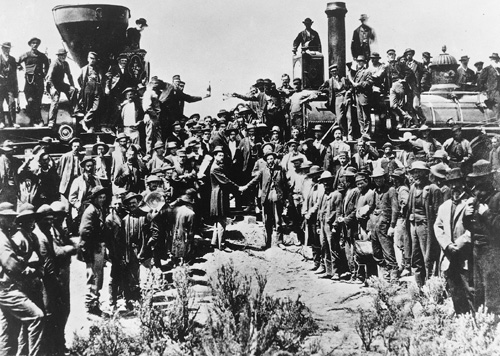
Here is a photograph of the gathering, preserved by the National Archives. People stand beside the track and climb onto the locomotives. At the center, two men reach across the space between the engines. The crowd makes the meeting visible in a way that a list of dates cannot. Yet the picture has limits. It does not let us weigh a spike, test its metal, or read every inscription. For those details, we need the object histories. The photograph records a celebration. The inventory explains what the people had brought to celebrate with.
The gold spike carried an early date
The best-known gold spike began with David Hewes, a San Francisco contractor and friend of Central Pacific president Leland Stanford. Hewes wanted a special object to mark the railroad's completion. He paid to have a gold spike cast in San Francisco and engraved on its sides and head. One inscription recorded a completion date of May eighth, eighteen sixty-nine. The ceremony actually took place two days later. That difference does not make the object false. It tells us the engraving belonged to an earlier plan. A commemorative object can preserve an expectation as well as the event that finally happened.
Nevada added silver
Nevada's contribution was silver. Unlike the cast gold spike, this one was forged. The National Park Service describes silver being supplied in Virginia City, shaped by a blacksmith, and hurried to Reno to meet Stanford's train. The railroad ceremony was attracting gifts from beyond either company's boardroom. Each offering connected a place with the new line. Gold represented one contribution, silver another. That is why calling everything at Promontory the Golden Spike can hide part of the story. Nevada did not send another copy of the same object. It sent a different metal, prepared in a different way.
Arizona combined three metals
Arizona Territory presented a spike that combined three metals. Its core was ordinary iron. The head was plated with gold, and the shaft with silver. The difference matters. A gold-colored surface is not the same thing as a solid gold object, and an attractive modern photograph cannot settle that question on its own. The historical description gives the construction. Arizona's offering was part working material, part ceremonial display. Its engraved message linked the territory to the enterprise connecting the continent. Four ceremonial spikes did not mean four identical objects. Even the materials carried different messages about the people presenting them.
The other golden spike
There was also a second gold spike. Frederick Marriott, proprietor of the San Francisco News Letter, ordered it as the newspaper's offering to the railroad celebration. This is the object most easily lost when the entire event is reduced to one famous souvenir. The National Park Service records its presence in the four-spike story, but says its later whereabouts are unknown. Suggestions about where it went are not the same as a documented chain of ownership. We can count it among the ceremonial offerings without pretending we know where it is today. That small distinction keeps a mystery from turning into an invented discovery.
Precious objects came back out
The setting for these gifts was carefully prepared. A polished laurelwood tie had four holes drilled to receive the ceremonial spikes. A special silver-plated hammer, called a maul, joined the presentation. These were objects to display and preserve. After their part in the ceremony, the precious spikes and the special tie were removed. Ordinary iron spikes and a pine tie took their place. The working iron spike and hammer were connected to the telegraph, allowing the completion signal to travel beyond the people standing at the track. The railroad's lasting connection depended on ordinary materials after the extraordinary gifts had done their work.
The work behind the ceremony
The celebration also stood on years of labor that cannot fit inside one photograph. Thousands of Chinese workers helped build the Central Pacific through difficult terrain and dangerous conditions. They worked in many roles, including construction, masonry, carpentry, and the handling of track materials. The National Park Service describes unequal pay and a strike in June eighteen sixty-seven over wages and hours. It also records Chinese workers placing the final rail on the morning of the ceremony. Stanford's research project places that labor at the center of the railroad's history. The spikes deserve attention, but they did not build the line. People did.
What the four spikes explain
The four spikes give us a useful way to remember Promontory. Two were gold, one was silver, and one combined an iron core with precious-metal plating. The famous gold spike carried a date that the actual ceremony had already passed. All four belonged to a presentation whose valuable objects were removed from the working track. And the crowd between the engines was only one visible moment in a much larger labor story. The companion source trail brings together the photograph, the spike descriptions, and the workers' history. Put them side by side, and the familiar golden symbol becomes a richer account of what happened at the meeting of the rails.
Explore the source trail
These sources are free to read. No purchase or newsletter signup is required.
-
Four Special Spikes: The Golden Spike; Nevada’s Silver Spike; Arizona’s Gold and Silver Spike; A Second Golden Spike; The Laurelwood Tie; The Ceremony; A Scattering of History
-
The Golden Spike in the Transcontinental Railroad: Main paragraph beginning The Transcontinental Railroad was completed
-
Joining the tracks for the first transcontinental railway: Complete image caption; linked 51c.jpg photograph and archival caption
-
East and West Shaking Hands: catalog and rights: Dublin Core: Creator, Date, Rights and Source
-
Chinese Labor and the Iron Road: Paragraphs on working conditions, June 1867 strike, April 1869 track laying, and ceremony
-
Chinese Railroad Workers in North America Project: Introductory paragraph below photograph caption
Compare the objects
| Object | What the sources describe |
|---|---|
| David Hewes’s gold spike | A cast gold commemorative spike engraved with the earlier planned completion date, May 8, 1869. |
| Nevada’s silver spike | A forged silver offering sent to meet Stanford’s train at Reno. |
| Arizona Territory’s spike | An iron core with a gold-plated head and silver-plated shaft. |
| The newspaper’s second gold spike | Frederick Marriott’s offering; its later whereabouts are unknown in the NPS account. |
The National Archives photograph records the gathering. It cannot establish the weight or composition of the individual spikes. Compare it with the object histories rather than treating the picture as evidence for every detail.
Image and narration credits
A. J. Russell, 1869 / National Archives, Bureau of Public Roads. Public domain.
Narration uses the Kokoro af_nicole synthetic voice. Historical photographs and their dates are identified separately from explanatory text. The linked sources support the historical account.
Get the Old West Dispatch
Weekly insights on old west — delivered to your inbox. No spam, unsubscribe any time.
Want to choose specific topics? Customize your interests
Get the Old West Dispatch
Weekly insights on old west — delivered to your inbox. No spam, unsubscribe any time.
Want to choose specific topics? Customize your interests