Ready to put this into action?
Get the complete Treasure Hunter's Research Guide — Pioneer self-reliance principles — situational awareness, terrain reading, and the research mindset.
Coronado’s Search for Gold: What He Actually Found at Quivira
The complete narration, historical sources and research notes for this Western Stories episode.
Recommended Resource
Treasure Hunter's Research Guide
Pioneer self-reliance principles — situational awareness, terrain reading, and the research mindset.
Explore the evidence behind this Western Stories episode, then follow the source links to read the records for yourself. This page includes the complete narration and a research guide.
The story
A real place beneath a golden expectation
Coronado did reach Quivira. The place was real. The golden kingdom he expected was another matter. In a report to the king of Spain, the expedition's commander described grass houses, fields of corn, and country that impressed him for its soil and water. He also had to explain why a journey driven by reports of extraordinary wealth had failed to produce it. That difference is the heart of this story. We are following a treasure expectation across the Southwest and onto the plains, then comparing it with the people and places the travelers actually encountered. The answer is more revealing than a simple tale of a lost city.
Why the next rich kingdom seemed possible
By the early sixteenth century, Spanish conquest in the Americas had brought enormous wealth into imperial hands. That experience encouraged the belief that another rich kingdom might lie beyond the next frontier. Reports of substantial settlements to the north entered a world already prepared to hear them as promises. Cibola became attached to the expectation of wealthy cities. But an expectation is not a measured inventory. Descriptions passed between people with different languages, aims, and ideas of what counted as wealth. Once the story reached officials deciding whether to support an expedition, the most exciting version could carry a great deal of weight. Coronado's journey grew from that setting.
The report that brought an army north
In fifteen thirty-nine, the friar Marcos de Niza traveled north on a reconnaissance ordered by the viceroy of New Spain. Esteban, an enslaved African with experience traveling through the region, went ahead of him. Marcos returned with news that Esteban had been killed at the Zuni pueblo of Hawikuh, and with a greatly enlarged picture of the settlements he claimed to have seen. The following year, Francisco Vazquez de Coronado led a much larger expedition north. It included Spanish soldiers and a still larger body of Indigenous allies. This was not a lone treasure hunter walking into empty country. It was a substantial force entering places where people already lived.
Hawikuh did not match the promise
In July fifteen forty, the expedition reached Hawikuh, in what is now New Mexico. The settlement did not match the promised city of gold. It was a Zuni pueblo whose residents were prepared to defend it. The encounter became an attack, and the Spanish forces took possession of the village. Food stored there mattered immediately to the newcomers. The captured settlement then served as a headquarters. This moment changes the meaning of the search. The absence of expected gold did not make the expedition harmless. Its hunger, military power, and demands fell on the people whose homes stood where outsiders had imagined a treasure kingdom.
The people were not a vanished legend
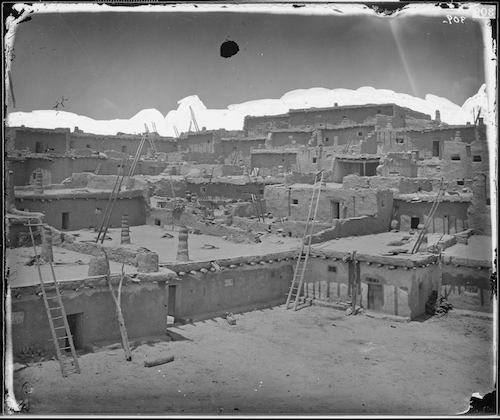
This photograph shows Zuni Pueblo in eighteen seventy-three, more than three centuries after Coronado's arrival. It is not a picture of Hawikuh during the attack, and it cannot tell us exactly how that earlier village looked. Its date matters as much as its subject. The buildings, ladders, and occupied spaces belong to a later photograph of a living community. A familiar treasure legend can make the people in the story seem like scenery that disappeared when the explorers went away. The historical record asks for something more precise. Hawikuh was a community before it became the object of a Spanish search, and Zuni history extends far beyond that encounter.
A hard winter in the Rio Grande country
The expedition did not stop with its disappointment at Hawikuh. Parties traveled farther into the Southwest, and the army wintered in the Pueblo country along the Rio Grande. At Tiguex, relations deteriorated into violent conflict. The National Park Service account describes Spanish forces killing the occupants of one pueblo and forcing people from others. When Coronado later wrote to the king, he presented events through the language of conquest and pacification. That was the commander's explanation to his sovereign. It was not the experience of the households facing an armed force. Keeping both perspectives in view prevents the hunt for treasure from swallowing the history of the people in its path.
Quivira moved the promise farther east
A new report offered another destination. A Plains guide, remembered in Spanish accounts by the name the Turk, described a land called Quivira farther east. Hope shifted with the story. In his later letter, Coronado said that some reports had reached him largely through signs. He also described language barriers that made inquiry difficult. These admissions matter. We do not possess a recording of what each person said or meant. A description could be misunderstood, enlarged in retelling, or heard through the listener's desire for it to be true. The expedition nevertheless set out again. In the spring of fifteen forty-one, Quivira became the next place where expectation would meet reality.
The plains put the expedition under strain
Coronado's report describes immense plains where familiar landmarks were scarce. He wrote about poor water, the exhaustion of the corn carried by the expedition, and dependence on the animals the men killed for food. Reports from people met along the way challenged the guides' descriptions of multistory stone houses. The commander sent most of his force back toward the Rio Grande settlements and continued with a smaller mounted party. This was no effortless march from one fabulous city to the next. The practical questions were immediate: where to find water, how to feed the men, and whether the next account of the destination was more reliable than the last.
Quivira was inhabited, cultivated country
When the smaller party reached Quivira, the buildings were not the stone towers described in the most ambitious reports. Coronado wrote about grass houses and people who planted corn. The Wichita and Affiliated Tribes identify the Quivirans encountered in fifteen forty-one as their ancestors. Their history places these communities in the country around the Great Bend of the Arkansas River. Quivira was not an empty spot waiting to receive a Spanish name and purpose. It was inhabited country, with settlement, food production, and connections to other peoples. The travelers had reached a real destination. What failed was the fit between that destination and the riches they had been led to expect.
The metals in Coronado’s own report
The letter contains a detail easily flattened in later retellings. Coronado did mention metal. He described copper, including a piece worn by a leader, and a small piece that looked like gold. But he could not establish where that gold-like piece came from. He suspected it might have passed from people traveling with his own expedition. That is not evidence of a local gold industry, much less a city built from precious metal. It is an uncertain object in a report that failed to confirm the promised wealth. The careful conclusion is narrower than either extreme. He did not find the expected golden kingdom, but saying that he encountered no metal at all misrepresents his own account.
A report to the king was also a defense
Coronado praised the land at Quivira for its soil and water. He could recognize agricultural promise even while measuring the expedition against the king's interests. His letter also insisted that people had not been harmed by him or his company. That claim sits uneasily beside the wider account of the expedition's violence. Spanish forces eventually killed the guide they called the Turk. Whether he deliberately misled them, and how much misunderstanding shaped the story, remains disputed. A confession reported by the people holding a guide in their power does not settle his intentions for us. The commander's report is essential evidence, but it is also an explanation written by a man defending his actions.
The Wichita account changes the emphasis
The Wichita nation's history describes people tending gardens beside grass-house villages, hunting buffalo and other game, and participating in extensive trade. Goods connected them with Pueblo communities in New Mexico and Caddo communities farther south and east. Seen from that history, the absence of the Spaniards' expected gold is only one detail. Food, skilled work, trade relationships, and knowledge of the country supported life there. These communities had purposes that did not depend on satisfying a foreign expedition. Reading their history alongside Coronado's report changes the central question. Instead of asking only what the treasure seekers failed to get, we can ask what they encountered and how poorly their expectations prepared them to understand it.
The journey ended; the evidence remained
The expedition returned to Mexico in fifteen forty-two without the fabulous wealth that had set it in motion. Cibola and Quivira remained powerful names, but the people and places behind them were more complicated than the promise. The surviving account gives us occupied pueblos, warfare, grass-house villages, cultivated land, trade, and uncertain pieces of metal. It does not give us proof of a golden city waiting for the next searcher. The companion source trail links the complete published letter, the expedition history, and the Wichita nation's account. Together they show why a failed treasure expedition can leave a rich historical record, provided we listen for more than the disappointment of the men who wanted gold.
Explore the source trail
These sources are free to read. No purchase or newsletter signup is required.
-
Stories: The Mythical Seven Cities of Cibola: Complete narrative: Marcos and Esteban; departure and Hawikuh; Tiguex conflict; Quivira; guide’s death and disputed intent; 1542 return.
-
Coronado to the King, October 20, 1541: complete letter in Winship’s published translation: Printed pages 580–583: Translation of a letter from Coronado to the King, October 20, 1541. Complete letter, from heading through signature.
-
Wichita and Affiliated Tribes: In the Beginning, 1540–1750: Complete page; paragraphs on movement to the Great Bend of the Arkansas, Quiviran ancestors, grass-house villages, farming, hunting and trade.
-
Zuni Pueblo, 1873, Timothy H. O’Sullivan: image and rights caption: Caption directly below the 1873 Zuni Pueblo photograph; historical photograph and source credit.
Read the accounts side by side
Begin with Coronado’s complete October 20, 1541 letter in George Parker Winship’s published translation, then compare the Wichita and Affiliated Tribes’ history. A commander reporting to his king and a community describing its ancestors bring different concerns to the same encounter.
The letter mentions copper and an uncertain gold-like piece. Those details matter: failure to find the expected golden cities does not mean an absence of metal, and an uncertain object does not establish a local gold deposit.
The intentions attributed to the guide known in Spanish accounts as the Turk remain disputed. The later Zuni photograph dates to 1873; it does not show Hawikuh in 1540. No exact modern treasure location or excavation instructions follow from these sources.
Image and narration credits
Timothy H. O’Sullivan, Zuni Pueblo, 1873 / National Archives and Smithsonian. Public domain.
Narration uses the Kokoro af_nicole synthetic voice. Historical photographs and their dates are identified separately from explanatory text. The linked sources support the historical account.
Get the Treasure Dispatch
Weekly insights on treasure hunting — delivered to your inbox. No spam, unsubscribe any time.
Want to choose specific topics? Customize your interests
Get the Treasure Dispatch
Weekly insights on treasure hunting — delivered to your inbox. No spam, unsubscribe any time.
Want to choose specific topics? Customize your interests