Ready to put this into action?
Get the complete Treasure Hunter's Research Guide — Pioneer self-reliance principles — situational awareness, terrain reading, and the research mindset.
Roman Dodecahedra: What Were They Used For? | Salars
A research-based look at Roman dodecahedra, their archaeological contexts, practical theories, ritual interpretations, and unresolved purpose.
Recommended Resource
Treasure Hunter's Research Guide
Pioneer self-reliance principles — situational awareness, terrain reading, and the research mindset.
Roman Dodecahedra: What Were They Used For?
Roman dodecahedra were hollow, knobbed copper-alloy objects with twelve pierced faces, usually found in the northwestern Roman world. Their exact use remains unresolved. A valued symbolic or ceremonial role is a reasonable provisional interpretation, while wax-forming is the strongest recent practical challenger and rangefinding is mechanically possible but historically unproven.
The honest answer is that no ancient instruction manual has been found. These objects are not a solved “Roman mystery device.” They are a small, unusual artifact class whose shape can support several jobs, but whose archaeological contexts rarely show the moment of use.
The most useful way to study them is to separate three questions: can a replica perform a task, did ancient people use the object that way, and was that the purpose for which it was made?
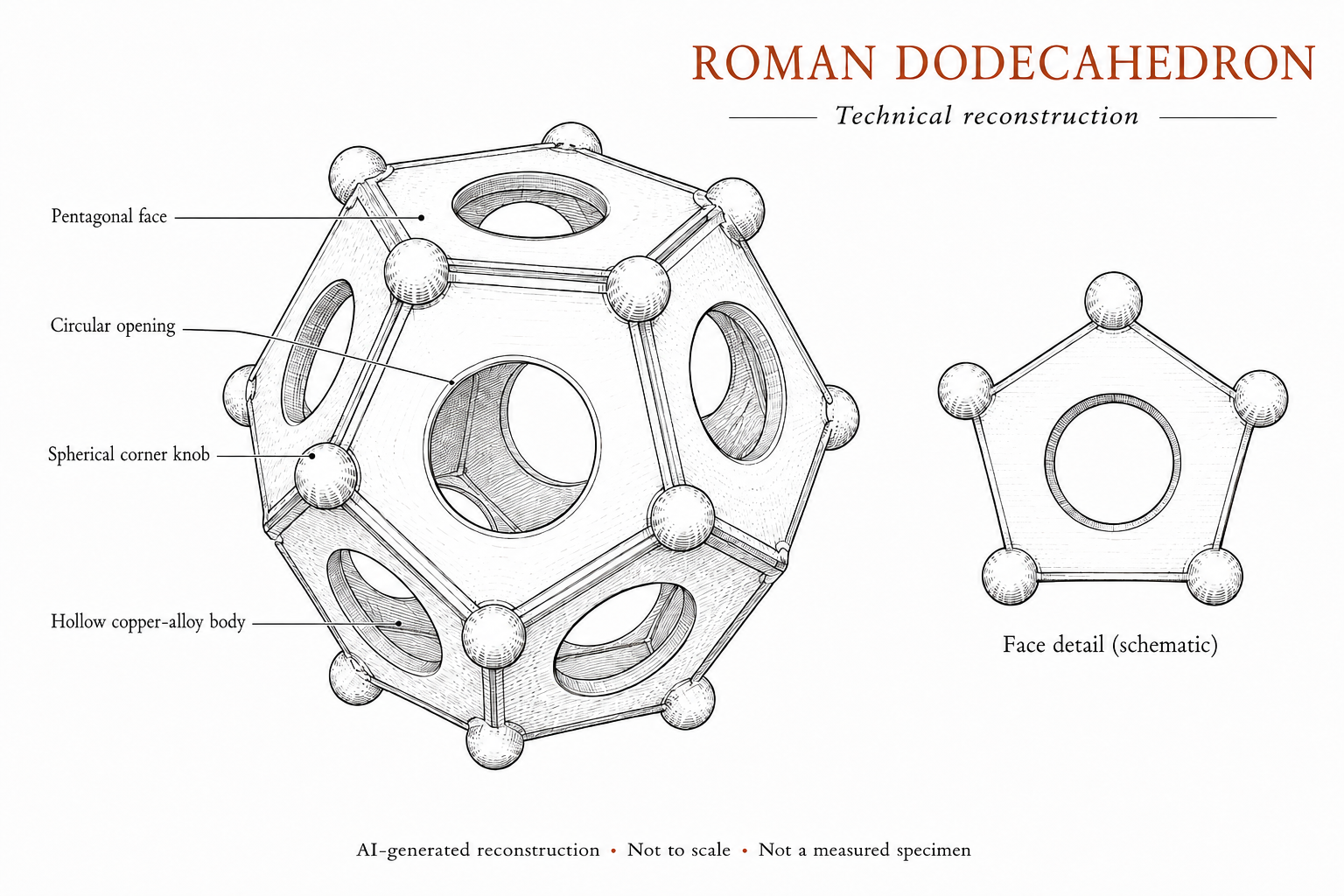
AI-generated technical reconstruction, not to scale and not a measured specimen. The schematic illustrates the general form; individual artifacts vary in proportions, openings, and surface detail. Its design was informed by English Heritage's Corbridge Roman Museum example, which has circular openings of varying sizes and spherical corner projections. The drawing does not establish what the objects were used for. Select the image to view it at full size.
The short verdict
- Best-supported broad reading: a valued symbolic or ceremonial object, possibly connected with divination or status.
- Strongest practical challenger: a tool for forming standardized wax objects, supported by a 2026 reconstruction but not by a demonstrated ancient wax match.
- Mechanically feasible, historically unproven: rangefinding or sighting.
- What the evidence does not justify: calling every dodecahedron a fortune-telling device, knitting tool, candle holder, or survey instrument with certainty.
What are Roman dodecahedra?
The familiar objects are hollow copper-alloy polyhedra with twelve pentagonal faces. Each face has a circular opening, usually a different size, and each corner carries a rounded knob. Most examples belong broadly to the second through fourth centuries and cluster in the northwestern Roman provinces. The Grand Curtius catalog describes the form and its lost-wax manufacture, while noting that examples vary in size and detail. See the Grand Curtius catalog.
They are sometimes described online as “Roman” in a way that implies a single standardized imperial device. That is too neat. A 2025 study records fragments from Hurbanovo and Chotín in present-day Slovakia, beyond the usual Roman frontier zone. The authors discuss the possibility of secondary metal reuse, so the fragments do not solve the purpose question, but they do make absolute claims about distribution unsafe. Read Dragonidesová's 2025 study.
Why the mystery persists
The objects have no surviving labels, no securely identified attachment, no agreed standard of dimensions, and no ancient text that names them. A proposed use must therefore be tested against shape, wear, manufacture, find context, and the pattern of variation across specimens.
What do the archaeological contexts show?
Context does not automatically reveal function, but it tells us what kinds of people owned, stored, buried, or discarded these objects. Several contexts are especially useful because they complicate one-hypothesis explanations.
Jublains: a commercial setting
A dodecahedron was recovered with a precision balance from the destruction layer of a burned cellar building. The excavators considered a commercial or merchant context. This is important counterweight to a purely religious story, but it does not prove that the dodecahedron itself was a measuring gauge: a merchant could own, store, sell, or inherit an unrelated valued object. Read the Jublains excavation report.
Gloucester: possible sanctuary material
A dodecahedron fragment is associated in later literature with the Gloucester hoard, whose study proposes material from a local temple or shrine. That makes a ritual or dedicatory life plausible, but a hoard interpreted as sanctuary material records deposition, not a witnessed operating procedure. See the Britannia study of the Gloucester hoard.
Krefeld-Gellep: a possible handle
One grave find lay beside a rod-like bone object. A handle or staff attachment is conceivable, but the bone was poorly preserved and the association does not prove that the pieces were joined. Grüll's review discusses the find.
Norton Disney: important, but not final
The complete 2023 find was recovered from a pit. The discoverers report preliminary XRF results of roughly 75% copper, 7% tin, and 18% lead and favor a local religious interpretation. Their detailed 2023–2024 excavation reports remain unreleased while evaluation continues, so the composition and theory should be described as preliminary rather than settled. Discoverer's account and report-status page.
Could they have been practical tools?
Wax forming: the strongest new challenger
In a reviewed 2026 EXARC article, Greg Lamb tested whether a dodecahedron-like form could press softened wax around cords. The knobs limited thickness, one opening created a raised center, and larger openings helped release the formed piece from the hollow interior. A representative 3D-printed model produced ten cord-free tokens in about five minutes; a hand-formed comparison was functionally similar. Read the EXARC experiment.
This is meaningful evidence of capability, not proof of ancient intent. The test used one maker, a PLA model rather than an exact bronze original, and no ancient wax object was matched to a particular artifact. The decisive follow-up would compare an exact bronze replica with a much simpler footed plate under the same wax, cord, operator, and timing conditions.
Rangefinding: geometry that works on paper
A 2012 preprint models distance estimation through two opposing openings. With a target of known height, the separation of the holes, and a difference between aperture diameters, similar triangles can produce a range estimate. The paper also acknowledges incomplete measurement uncertainties and the absence of a demonstrated common calibration standard. Read Sparavigna's analysis.
That makes rangefinding mechanically possible, not historically established. A field instrument needs repeatable geometry, a calibration rule, and evidence that people actually used it. A museum page may call the objects surveying instruments, while other museums and scholars favor ritual; neither kind of consensus wording substitutes for a blind test with original measurements. The Hunt Museum's surveying proposal is a useful example of the argument, not a final verdict.
Other practical proposals
Solar or sowing-date instruments, glove or textile tools, gauges, lamps, dice, and craft demonstration pieces can all be made to sound plausible because the geometry is flexible. The problem is not inventing a possible action; it is finding a distinctive ancient match in wear, residue, attachment, text, or context. Different hole sizes do not by themselves prove different finger sizes, and a possible secondary use does not explain why the original object was made.
Why does a ceremonial interpretation remain plausible?
The unusual geometry, expensive manufacture, and occasional association with graves or interpreted sanctuary material make a symbolic or ceremonial role reasonable. The Gallo-Romeins Museum connects the form with Platonic cosmic symbolism, while a 2025 paper by Michael Guggenberger and Stephen Leach proposes a historically situated link to ideas about cosmic “receptacles” and theurgic divination. See the museum interpretation and the 2025 Antiquaries Journal paper.
But “symbolic” is not the same as “supernatural,” and a philosophical resemblance is not an operating manual. The 2025 paper itself treats the exact use as unresolved. It also questions the reliability of the oft-repeated yellow-wax report from Feldberg in 1892 and notes that more than half of recorded find locations are settlements, while only a minority have plausible sacred associations. Those cautions matter: they prevent a few dramatic finds from being mistaken for the entire corpus.
A treasure-hunter's evidence rule
A temple deposit tells you about deposition. A cellar tells you about ownership or storage. A grave tells you about association. None automatically tells you how an object was operated. Context is strongest when paired with residues, use-wear, attachments, or a distinctive match to a product made with the object.
What would actually settle the question?
The next step is not another list of imaginative uses. It is a controlled comparison between the artifact class and the physical traces predicted by each use.
- Document originals consistently. Record every aperture, paired diameter, face separation, wall thickness, knob, repair, and conservation history.
- Test residues before cleaning. Look for wax, resin, fiber, soot, or pigment with contamination controls; residue alone may still be ambiguous.
- Compare wear blindly. Use exact bronze replicas for wax, cord, gauge work, handling, and mounting, then compare marks without telling analysts the proposed use.
- Test simpler alternatives. A wax-forming claim should beat a simple footed plate, not just demonstrate that the dodecahedron can work.
- Seek a distinctive ancient match. A wax impression that matches one artifact's apertures, rings, and defects would be much stronger than generic wax.
- Allow multiple life histories. Some objects may have served different functions, or a ceremonial object may later have become a useful tool, possession, or scrap-metal source.
Ongoing research into chemistry, manufacture, and use-wear is more valuable than a confident viral caption. For a broader research method, see our guides on how historians test legends and which sources to trust.
Final determination
My provisional choice is a regional symbolic or ceremonial implement, possibly connected with divination. Wax forming is a valuable practical challenger. Rangefinding is physically possible but historically unverified. The responsible answer is not that the mystery is solved; it is that the evidence now tells us which tests could make progress.
Research notes and sources
This article summarizes archaeological publications, museum records, a reviewed reconstruction, and a preprint consulted on September 6, 2026. No original object was handled, and the Norton Disney specialist appendices were not available for independent inspection. Claims are intentionally labeled as reported, proposed, or tested rather than presented as settled fact.
- Guggenberger & Leach, “The Gallo-Roman Dodecahedron and the Receptacle of All Becoming” (2025)
- Lamb, “A Functional Reassessment of Roman Dodecahedra as Tools for Forming Standardised Wax Objects” (EXARC, 2026)
- Guillier, Delage & Besombes, Jublains excavation report
- Coombe & Henig, “The Gloucester Hoard of Roman Bronze” (2020)
- Norton Disney History & Archaeology Group, discovery account and report-status page
- Sparavigna, “Roman Dodecahedron as Dioptron” (2012 preprint)
Get the Treasure Dispatch
Weekly insights on treasure hunting — delivered to your inbox. No spam, unsubscribe any time.
Want to choose specific topics? Customize your interests
Get the Treasure Dispatch
Weekly insights on treasure hunting — delivered to your inbox. No spam, unsubscribe any time.
Want to choose specific topics? Customize your interests